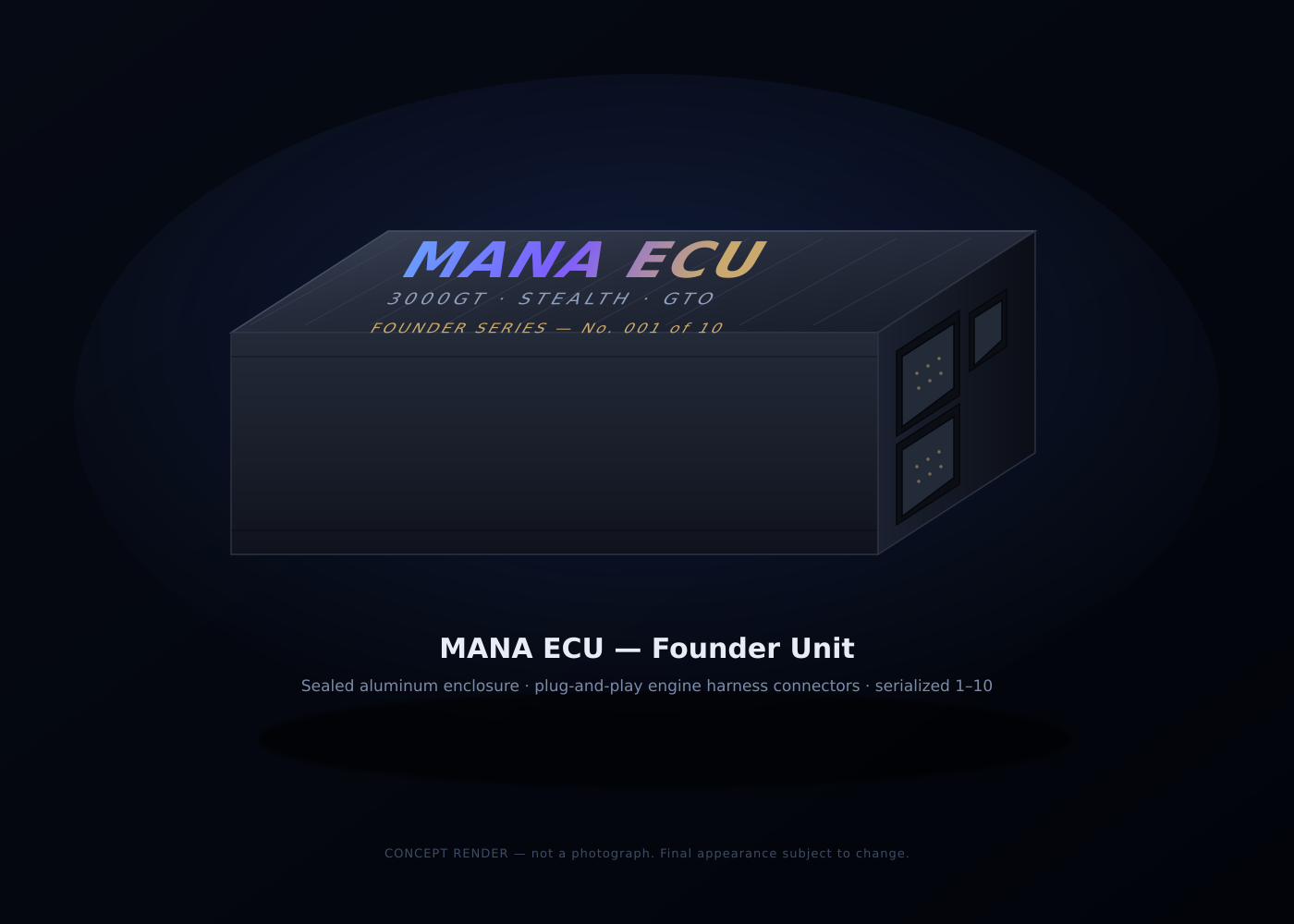
Mitsubishi 3000GT · Dodge Stealth · Mitsubishi GTO

MANA ECU

Adds six to your mana pool.

The first true plug-and-play standalone ECU built for the entire platform — every year, every engine, stock to 1000 HP. Plug it in. It runs.

Founding Batch — only 10 units
Reservations lock in the first production run.

Why this exists

I own a '92 Stealth R/T. The factory ECUs in these cars are dying of old age, there's no replacement, and this platform is one of the worst to convert to a standalone. Your options today: buy a generic ECU, build a custom harness, then find one of the few tuners in the country who knows a 6G72.

So we built the thing that should exist: an ECU that plugs into your factory connector, comes preloaded with a validated tune for your exact car, and starts. Bone stock or fully built, same board.

What makes it different

Truly plug-and-play

Mates the factory ECU connector through a generation adapter. No cut wires. Reverts to stock by unplugging.

Preloaded & running

Ships with a validated tune for your exact year, engine, and build level. It starts the first time.

Stock to 1000 HP

One board covers stock, bolt-ons, big-turbo, and full race — high-Z & low-Z injectors, COP, E85, boost control.

Every year, every engine

1991–1999. SOHC NA, DOHC NA, and DOHC twin-turbo. Gen1, Gen2, Gen3 — one product line.

Under the hood

Fuel & spark6-cylinder sequential injection + ignition, COP-ready, wasted-spark and coil-pack conversion support for the older cars
TriggerReads the factory optical crank sensor directly. This is the part that makes 3S standalone swaps hard, and it's handled. Aftermarket crank-trigger ready.
OnboardWideband AFR controller, knock control, MAP + baro, SD-card datalogging, USB + dual CAN, wireless tuning
Talks to your carDual CAN bus for modern digital dashes, gauges and telemetry — plus a bridge to the factory module network, so your ECU can share data with the rest of the car
Tuner featuresBoost control, 2-step launch, anti-lag, flat-shift, flex-fuel, EGT, nitrous/meth outputs, gauge/CAN dash feed
Two connectorsA — factory plug-and-play (stock cars). B — expansion for all the extra features (built cars).
Fits your yearThe factory connector changed across the platform's life — your kit includes the correct generation adapter for your exact car, so it's a true plug-in. Just tell us the year.
Tuning softwareOur own tuner — live tuning link, per-circuit health dashboard, one-click diagnostic reports, datalog review
One board, three generation adapters, the whole platform. 1991–93, 1994–97, and 1998–99 used different factory ECU connectors. We build the matching adapter for each, so the same ECU drops into any 3000GT, Stealth, or GTO. The firmware is ours, written from scratch for these cars. Every safety check, every diagnostic, every tune was developed on this platform, and it ships as a finished product with our validated tunes and support behind it.

The Diagnostic Suite

It tells you what's wrong before you ever leave the driveway. These cars are 30+ years old. The harness is aging, the connectors are corroding, and every owner knows the gremlins: the intermittent no-start, the stumble that never happens at the shop, the code that just says "sensor circuit." A stock ECU throws a vague number. MANA finds the actual broken wire and explains what happened.

Key-on: the pre-drive health check

Turn the key. Before the engine cranks, the ECU runs a full self-diagnostic in about two seconds and gives you a straight answer: GO / CAUTION / NO-GO, with a plain-English list of anything it found:

Power self-testEvery internal rail, battery voltage, processor, memory and CAN checked before anything else runs
Harness sweepEvery sensor circuit checked for open, short, or degraded resistance; every injector and coil channel polled for open-load and shorts
Sensor sanityCold-soak plausibility snapshot — do the sensors agree with each other before you drive?
The verdict"READY." Or: "CAUTION: rear O2 heater open (pin 76) — closed-loop degraded." Or: "DO NOT DRIVE: injector 3 circuit open (pin 14)."
What changedNew faults are diffed against your last key-on — you see what changed since yesterday, not a wall of history

It points at the wire, not at a code number

Harness self-testActive resistance sweep of every circuit, classified OPEN / SHORT / IN-RANGE / DEGRADED. Degraded means drifted resistance — corrosion and chafe caught before they become a no-start. Every result names the signal and the factory connector pin number, so you go straight to the wire.
Every output supervisedInjector and ignition drivers report open-load, short, and over-temperature per channel — an unplugged injector or a dying coil circuit is identified by cylinder, in seconds
Active testsEngine off, from the laptop: click each injector, fire each coil channel, cycle the idle stepper, toggle the fuel-pump and fan relays — and the ECU confirms each one actually responded. Bench-test the whole car without starting it.
Codes with reasoningEvery fault stores why it fired: a freeze-frame of RPM, load, temps and voltages at the moment it happened, plus a human-readable cause — "IAT open — signal pegged 5.0V at key-on, expected 0.5–4.5V; check pin 72 / IAT connector." All persisted to an onboard blackbox log that survives power loss.
Gremlin captureThe hard ones. Momentary sensor dropouts, voltage sags, ground bounce, trigger glitches — logged with timestamp and full conditions even when they self-clear. "It does it sometimes" becomes a dated, documented event list you can act on.
Catches lying sensorsCross-checks catch sensors that read in-range but wrong: MAP vs TPS vs RPM coherence, coolant-vs-air temp at cold soak, battery vs charging state — flagged as "implausible," distinct from open/short
Early warningTrend monitoring watches values drifting toward their limits and raises a WATCH before the hard fault — built from documented 3S failure patterns: crank-angle sensors that fail as they warm up, knock-sensor and TPS grounds that corrode gradually, oil pressure sagging at steady state. Catch it when it starts, not a month down the line.
Electrical healthCharging-system monitor, alternator ripple, ground-integrity checks (sensor-ground offset detection), and supervision of every internal rail
The whole carBeyond the engine: reads factory module codes (ABS, SRS, climate) over the diagnostic bus and folds them into one report
Guided troubleshootingEvery fault points to the fix: the suspect wire, both connector endpoints (ECU pin and factory pin), expected vs measured value, and the next check to run. The ECU is the shop manual for its own harness.
One-click reportLive per-circuit health dashboard in the tuner, one-click scan report, shareable log — hand your tuner or your forum thread the whole picture
Why this matters on this platform: more 3S cars are sidelined by harness gremlins than by broken engines. Every diagnostic above reports against your car's factory pin numbers through the generation adapter — so a 1992 Stealth and a 1997 3000GT each get told exactly which pin on their connector to check.

The complete capability sheet

The full list. If it's not on here, don't assume it — ask us.

Engine control

Injection6-cylinder full sequential. High-impedance injectors natively; peak-and-hold for low-impedance race injectors — configured in software, no hardware change
Ignition6 channels: factory coils, wasted-spark conversions, smart coils, or full COP — with onboard high-energy ignition drivers, no external ignitor boxes
Output supervisionEvery injector and ignition channel reports open-load, short, and over-temperature individually — the ECU knows a dead coil circuit by cylinder
TriggerReads the factory optical crank/cam sensors directly — the hard part of this platform. Aftermarket crank-trigger ready. Trigger self-capture on first crank validates your car's exact pattern before spark is ever trusted
BoostClosed-loop boost control with overspeed and slew-rate safety cross-checks
IdleDrives the factory ISC stepper directly + PWM idle-valve output for conversions
Race features2-step launch control, flat-shift clutch input, spare PWM outputs for meth / VVT / second boost stage / nitrous control
Flex fuelGM ethanol-content sensor wires straight in — blend-aware fuel and spark, sensor-fault fallback

Sensing

WidebandOnboard controller — Bosch LSU 4.9 plugs into its own dedicated connector. Heater managed with proper level-shifted drive and health feedback; sensor diagnostics included
KnockDedicated knock processor with differential sensor input (rejects harness noise), frequency-windowed detection per cylinder-count, feeding spark-retard strategy
MAPOnboard absolute sensor to ~2.9 bar (≈27 psi boost) + external MAP input above that + barometric reference
Factory sensorsCLT, IAT, TPS, battery voltage — every input filtered, clamped, and biased for the factory sensors
Expansion sensing7 spare protected 0–5V analog inputs (oil pressure, fuel pressure, trans temp, whatever your build needs) + EGT expansion port
Every input protectedSeries limiting, over-voltage clamps, and TVS on every harness-facing pin — a shorted sensor or a miswired pin does not kill the ECU

Outputs & vehicle integration

Vehicle loadsFuel-pump driver, dual fan outputs (PWM-capable), A/C clutch control, check-engine lamp, factory tach feed — all through protected, fused, flyback-clamped driver stages
General-purpose2 spare protected low-side outputs (shift light, solenoids, relays)
CommsDual CAN (digital dash / telemetry + expansion), OBD-II port with K-line, dedicated tuning link
Factory modulesReads factory module fault codes (ABS, SRS, climate) over the diagnostic bus and folds them into one report
LoggingOnboard SD-card datalogging + a flash blackbox fault log that survives power loss
TuningUSB connection + our own tuner app: live tuning, per-circuit health dashboard, one-click diagnostic report, datalog review

Survivability

Power protectionReverse-battery protection (MOSFET, not a lossy diode), ISO 7637 load-dump clamping, survives cold-crank voltage sag without resetting
Sensor railsTwo independently protected 5V sensor feeds — a shorted sensor on one rail can't brown out the other
Firmware safetyWatchdog + brown-out supervision, graduated limp modes — a failed sensor degrades the tune, it doesn't strand the car. Every fault path raises a logged, reasoned DTC
TestingFirmware developed against hundreds of automated tests and a hardware-in-the-loop rig simulating the running engine — before it ever touches a real car

Become a Founding Member

The first 10 units are the founding batch. The people who back this now are the reason it gets built, and they get the first working ECUs in real cars. Your reservation funds the launch and locks your place in line. When your unit is built and validated, you get the complete preloaded kit: ECU plus the correct adapter for your car, ready to run.

Founding batch full? Reservations stay open — everyone after the founding 10 joins the preorder queue, and batch 2 builds in reservation order. Your place in line is your place in line.

$500
Flat. Complete founding kit — ECU + your generation adapter, preloaded and ready to run
10
Founding Member spots — then preorders continue in line

Where your reservation goes

We believe in being straight with the people funding this. The founding batch is transparently funded:

Your $500 (flat)The complete founding kit, paid once through Square — funds prototype fab, tuning & validation across variants. No second invoice.
Balance at delivery ($300)Funds building and testing your actual unit
10 founding unitsProve the product in real cars and seed the first production run

Claim your spot

Tell us your car. We'll confirm your reservation and your build profile.

For off-road / motorsport use only — not intended or certified for use on emissions-controlled vehicles operated on public roads. This is a product pre-order / reservation, not an offer of securities or a financial investment. Your payment reserves a physical product; it does not represent equity, ownership, or any promise of financial return. Payments are processed through Square and are refundable if the product is not delivered. Delivery timing is an estimate as we complete the founding batch. Initial release supports manual-transmission cars; automatic support to follow.